
No Responses
September 7, 2026
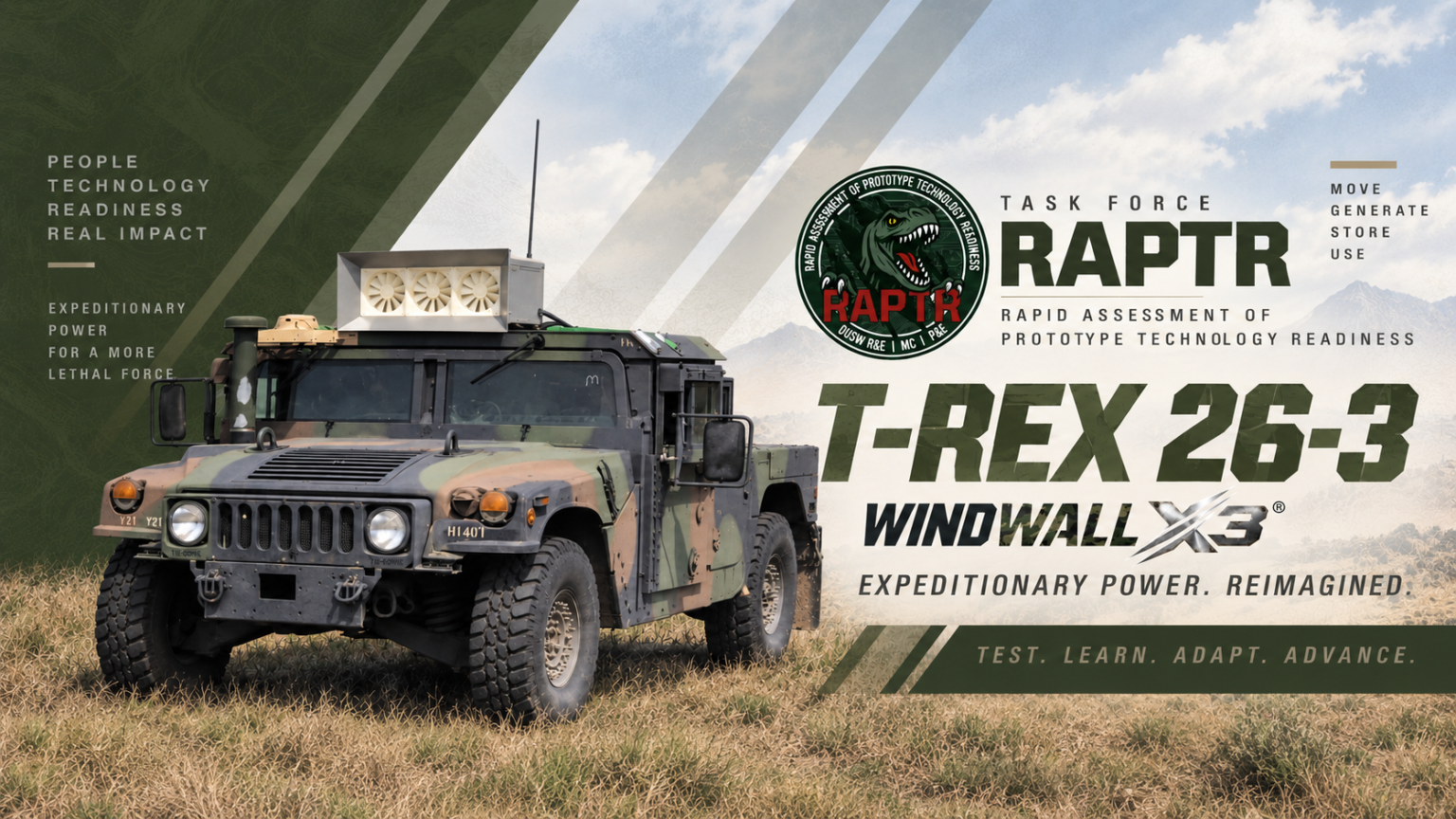
This past August, Sujen International completed participation in Technology Readiness Experimentation (T-REX) 26-3, where our emerging expeditionary power technology was evaluated in a mission-relevant environment alongside military, government, and industry partners.
Hosted by the Office of the Under Secretary of War for Research and Engineering and supported by Task Force RAPTR, T-REX is designed to accelerate the transition of emerging technologies by placing them into operationally relevant experimentation environments where technical maturity, military utility, integration, and mission relevance can be assessed.
For Sujen, T-REX 26-3 represented much more than an opportunity to demonstrate a technology. It provided the kind of environment required to challenge assumptions, identify engineering priorities, engage directly with Warfighters and evaluators, and better understand how an emerging power-generation platform may ultimately contribute to expeditionary operations.
WindWall® X3 in a Mission-Relevant Environment
During T-REX 26-3, Sujen participated within the event’s Resilient Power technology area. Event planning materials identified the system for both static power-support experimentation and vehicle-mounted mobile testing, giving the team an opportunity to evaluate the technology within a broader operational context.
That distinction is important. Laboratory and bench testing remain essential to technology development, but field experimentation introduces variables that cannot be fully recreated in a controlled environment. Integration requirements, operating conditions, user interaction, deployment considerations, and mission-driven expectations all contribute to a more complete understanding of what a technology must become before it can provide practical field utility.
T-REX 26-3 gave our team direct exposure to those realities.
The result was not simply a demonstration completed. It was a clearer set of questions to answer, assumptions to revisit, and engineering priorities to carry forward.
From StormCell to WindWall® X3
Viewers of the official T-REX 26-3 video will see the technology identified as StormCell, the designation used during the event.
As our product architecture and market positioning continue to mature, Sujen is advancing the platform under the WindWall® X3 identity.
WindWall® X3 reflects the direction of the platform as a modular expeditionary power solution intended to support future distributed and forward-operating energy requirements. The T-REX 26-3 experience now becomes part of that development path—providing field-derived insight that will inform ongoing system, electrical, mechanical, integration, and deployment improvements.
The technology can be seen at approximately the 1:00 mark in the official T-REX 26-3 video:
Watch the official T-REX 26-3 video:
https://youtu.be/XhcqZDaM6bE
https://youtu.be/XhcqZDaM6bE
The Value of Experimentation
T-REX is structured around more than showcasing emerging systems. Its value comes from bringing Warfighters, evaluators, government leadership, industry, academia, and mission partners into the same experimentation environment to assess technologies against operational problems and determine what should happen next.
That approach strongly aligns with Sujen’s development philosophy.
Emerging technology improves when assumptions are challenged early. Engineering becomes more relevant when developers can hear directly from prospective users. And transition becomes more achievable when technical development remains connected to actual mission requirements.
T-REX 26-3 provided all three.
The experience sharpened our priorities, strengthened our understanding of the mission environment, and reinforced the importance of disciplined experimentation as we continue advancing WindWall® X3.
Moving Forward
The lessons from T-REX 26-3 are already being incorporated into our development roadmap.
Our focus now is to translate field observations and evaluator feedback into measurable engineering improvements, continue maturing the WindWall® X3 platform, and prepare the technology for increasingly demanding experimentation and integration opportunities.
We extend our sincere appreciation to Task Force RAPTR, OUSW R&E, the Warfighters and evaluators, and the many military, government, and industry partners whose professionalism, expertise, responsiveness, and willingness to engage made the experience valuable.
We also want to extend a special thank you to our partners at New Use Energy (NUE), who graciously provided one of their portable power units for integration and testing with WindWall® X3 during the event. Their support gave our team an important opportunity to explore how WindWall® X3 could interface with an existing mobile energy platform as part of a broader expeditionary power architecture.
T-REX demonstrated what effective technology development should look like: expose the system to meaningful conditions, listen carefully, identify what matters, and return to engineering with greater clarity. For WindWall® X3, that process continues.
Test. Learn. Adapt. Advance.